
By Ron Ketterling, President, Business Automation Specialists of Minnesota, Inc.
A customer came to one of our clients’ counters to buy a firearm and handed over his driver’s license. The license said he was 5′8″. The man standing at the counter was 6′3″.
My client didn’t complete the sale.
That was the right call, and it’s the part of Form 4473 I’d put above everything else in this post. The form documents who received a firearm from you. If you haven’t truly confirmed who that person is, every other box on the form rests on nothing. No sale is worth that.
Identity Comes First
Federal rules require you to verify the buyer’s identity by examining a valid government-issued photo ID and recording it on the 4473. Examining means more than confirming the card exists. Does the photo look like the person in front of you? Do the height, eye color, and age make sense? Do the name, address, and birthdate match what the buyer wrote on the form?
A seven-inch difference is hard to miss. Most mismatches are subtler. That’s why the check has to happen on every transaction, not just when something feels off. And no rule requires you to finish a sale. If the buyer’s identity is in doubt, stop.
ATF’s inspection numbers show how often the form itself goes wrong. In fiscal year 2025, ATF issued 7,134 citations for failing to verify or record identification on Form 4473. Those sat alongside 31,006 citations for failing to complete forms as prescribed, 23,415 for failing to obtain a completed 4473, and 14,776 for failing to record NICS information.
Where the Rest of the Mistakes Start
Most 4473 errors come from the same handful of spots. Buyers leave answers blank, use abbreviations, or check the wrong firearm type. Staff miss things too, usually identification details and background check entries. A rushed signature date or a missing NICS transaction number can turn a clean sale into a citation.
Handwriting makes it worse. A sloppy 4 looks like a 9, and a faded pen can blur a serial number. Busy periods make everything worse again. Holiday weekends, gun shows, and new product launches push staff faster than their process can handle, and the shortcuts start there.
These errors don’t stay on the form. During an inspection, ATF reviews completed 4473s against your disposition entries. A serial number that doesn’t match your bound book raises questions, and the same mistake across hundreds of forms looks like a pattern.
A Counter Routine That Catches Problems Early
A consistent routine prevents more errors than any reminder taped to the register. Here’s what I recommend to our clients:
- Check the ID against the person, then against the form. Do it before running the background check. If the person doesn’t match the card, stop there.
- Start the buyer off right. Hand them a clean form, a black pen, and a reminder not to abbreviate.
- Have a second person review every completed form. A fresh set of eyes finds a blank field in seconds.
- Match the firearm description to the item in hand. Check the serial number, model, and type against your inventory.
- Record the background check result and transaction number right away. Waiting until closing time is how they get lost.
- Watch for multiple handgun sales. Two or more handguns to one unlicensed buyer, at one time or within five consecutive business days, requires Form 3310.4. It goes to ATF and your state or local police by close of business on the day of the sale. FFLs in Arizona, California, New Mexico, and Texas must also report multiple sales of certain semiautomatic rifles on Form 3310.12.
Some mistakes will still get through. When you find one after the transfer, follow ATF’s instructions printed with the form. Never alter the original. Make a photocopy. The buyer corrects only the buyer’s sections, your staff correct only the seller’s sections, and whoever makes a change initials and dates it. Attach the corrected copy to the original.
What an Electronic 4473 Can and Can’t Do
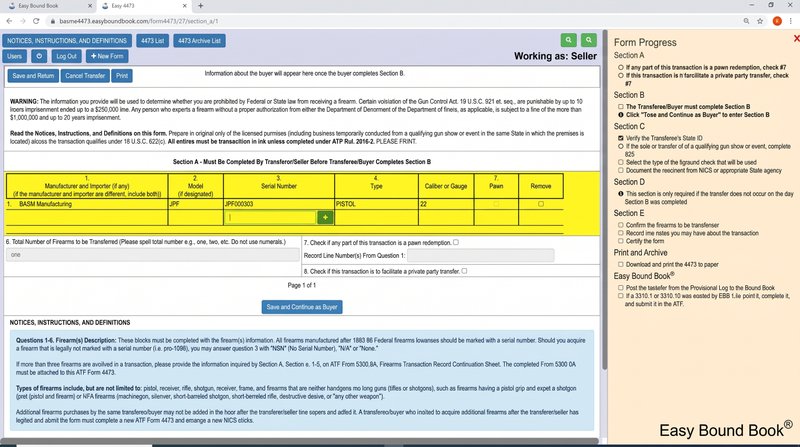
An electronic 4473 builds error checks into the form. It won’t let a buyer skip a required question. It flags inconsistent dates, missing signatures, and incomplete ID details. Typed entries end the handwriting problem, and staff spend less time hunting for blanks on a busy Saturday.
The biggest gain comes when the form connects to your other records. When the firearm details come straight from inventory, you eliminate the re-keying errors between the 4473 and the bound book.
But software can’t look across the counter. It can flag a blank field. It can’t tell you the man in front of you is seven inches taller than his license. That still takes a person paying attention.
The form itself is also changing. In May 2026, ATF proposed a major overhaul of Form 4473. The proposal would streamline identity and residency verification, extend how long a NICS check stays valid, and formally authorize electronic forms and auto-populated fields. It’s still a proposal, not a final rule. Whatever the final version looks like, the dealer’s responsibility to confirm who’s buying won’t go away.
Training Your Staff to Stop a Sale
Most new hires learn the 4473 by watching a busy coworker, and they pick up the shortcuts along with the steps. A written checklist at each register gives everyone the same foundation. Training built around real scenarios from your own store sticks far better than a generic walkthrough.
Make one point explicit: every employee has your permission to stop a sale. The person who notices something wrong is often the newest one at the counter, and the least likely to speak up unless you’ve told them it’s their job.
Then close the loop between each 4473 and its disposition entry. Pull a week of forms now and then and compare them with the bound book. You’ll catch drift long before an investigator does.

One Lost Sale
Under ATF Final Rule 2021R-05F, completed Forms 4473 must be kept until you discontinue your business. A form with an error, or a form documenting a transfer to someone who wasn’t who he claimed to be, stays in your records for as long as you’re licensed. Paper forms more than three years old can be scanned and stored electronically under ATF Ruling 2022-1, but a scan carries the same error as the original.
My client lost one sale that day. Given what the alternative could have been, that’s the best trade a dealer will ever make.
Our team has worked alongside FFL dealers since we created the industry’s original electronic bound book in 2008, and Easy Bound Book connects the counter, inventory, and A&D records in one place. If your counter process feels harder than it should, give us a call. We’ll walk through it with you.