
By Ron Ketterling, President, Business Automation Specialists of Minnesota
One of our manufacturing clients buys receivers from a subcontractor and builds them into rifles. When they set up Easy Bound Book, we walked them through how to record that. Acquire the receiver when it arrives. When it becomes a rifle, dispose of the receiver and acquire the rifle.
The owner didn’t want to bother. The receiver was already in the book, and two more entries for every gun felt like extra work for nothing.
Then ATF came in for an inspection. The investigators found those entries, and the company had to make nearly 24,000 corrections. They caught one break: they weren’t written up for late recordkeeping. But they still had to fix every record and change their procedures to the steps we had recommended in the first place.
I tell that story a lot, because it shows something licensees underestimate. Your acquisition and disposition record isn’t paperwork that sits off to the side of your business. It’s the record ATF uses to check everything else.
Why Investigators Start With the Bound Book
An ATF compliance inspection is mostly a records review. Industry Operations Investigators look at your Forms 4473, your licensing documents, and your inventory. The A&D record ties all of it together. Every firearm that comes in or goes out should be there, in order, on time, and described as what it actually is.
That last part is where my client went wrong. A receiver is a firearm the moment you acquire it. Once it becomes a rifle, what you have in inventory has changed, and your book has to show that change.
This isn’t a rare problem. ATF ran 8,472 firearm compliance inspections in fiscal year 2025. The most cited violation was failure to keep an accurate, complete, and timely A&D record under 27 CFR 478.125(e), with 40,763 citations. Manufacturers’ records, cited under separate sections, added roughly 12,700 more. No Form 4473 issue came close.

One Shortcut, Thousands of Entries
My client didn’t end up with 24,000 corrections because of one bad entry. They got there by making the same bad entry on every rifle they built.
Most A&D trouble grows the same way. Dealers have until the close of the next business day to record an acquisition and seven days to record a disposition. Manufacturers have seven days to record each firearm they make. Miss a deadline once and you have a correction. Miss it as a habit and you have a pattern. Patterns are what turn a routine visit into a warning letter or a warning conference. In fiscal year 2025, ATF issued 677 warning letters and held 547 warning conferences, and 83 inspections ended in revocation.
Explosives licensees see the same thing. In fiscal year 2025, their most cited violation was failing to keep the daily summary of magazine transactions accurate and current.
The Mistakes We See Most Often
Almost none of these come from bad intent. They come from busy weeks, staff turnover, and shortcuts that seemed harmless at the time.
- Recording what you bought instead of what you have. A receiver that becomes a rifle, or a firearm that gets rebuilt or converted, needs entries that reflect the change.
- Late entries. Acquisitions sit in a stack until someone has a quiet afternoon.
- Open dispositions. The gun is gone, but the book still says it’s on the shelf.
- Incomplete descriptions. Missing manufacturer, importer, model, serial number, caliber or gauge, or type.
- Serial number typos. One wrong digit and a firearm loses its paper trail.
- Overwritten corrections. Someone fixes an error by erasing it instead of correcting it the way ATF expects.
- Late PMF entries. Under ATF Final Rule 2021R-05F, a privately made firearm taken into inventory has to be marked and recorded within seven days, or before disposition if that comes first.
Habits That Hold Up Under Review
Clean records don’t take heroics. They take routine.
- Record at the moment of transfer. Make the entry part of receiving and checkout, not a separate chore.
- Write down your manufacturing procedure. If you assemble, convert, or rebuild firearms, document exactly which entries each step requires. My client’s procedure is now simple: acquire the receiver, dispose of the receiver, acquire the rifle.
- Reconcile on a schedule. Monthly or quarterly, compare what’s on the shelf with what the book says is open.
- Review open dispositions weekly. Catch firearms that left the building but never left the record.
- Use one correction method. Train everyone on the same documented process.
- Audit yourself once a year. Walk through your records like an investigator.
Reconciliation isn’t an ATF requirement on its own, but it’s the cheapest insurance you can buy. And if it turns up a firearm you can’t account for, you must report the theft or loss to ATF and local law enforcement within 48 hours of discovery.
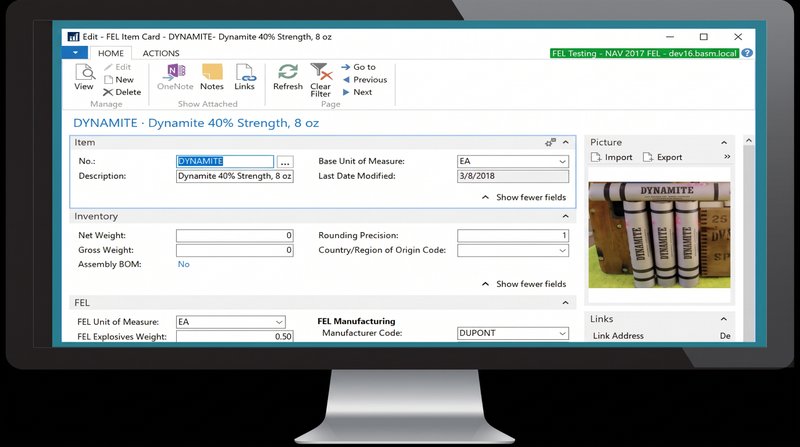
What Software Can and Can’t Do
My client’s story carries an uncomfortable lesson for someone who sells software. Easy Bound Book could record those transactions correctly the whole time. The shortcut was a choice.
A good electronic bound book that follows ATF Ruling 2016-1 can enforce required fields, link each disposition to a serial number, and keep a clean trail of every correction. It can’t make anyone follow the procedure.
Paper carries its own risks: handwriting, skipped lines, and lost pages. Under 2021R-05F, A&D records must be kept until you discontinue your business, so a lost page is a permanent gap.
Training closes the rest of the gap. Your staff need to know why each field matters and how to handle returns, transfers, and repairs. For example, under 2021R-05F a dealer can repair a firearm and return it to its owner the same day without logging it, but a firearm kept longer has to go in the book. Training built on your own records and workflows sticks far better than a generic walkthrough.
Two Extra Entries
Our team has been building electronic bound books since 2008, when we created the firearms industry’s original electronic A&D system. In that time, I’ve seen plenty of inspections go smoothly and a few go badly. The difference is rarely the software. It’s whether the book matches what’s really happening on the floor.
For my client, getting it right meant two extra entries per rifle. Compared with 24,000 corrections, that’s nothing.
If you want a second set of eyes on how your book handles receivers, conversions, or anything else, give our team a call. We’ll walk through it with you.